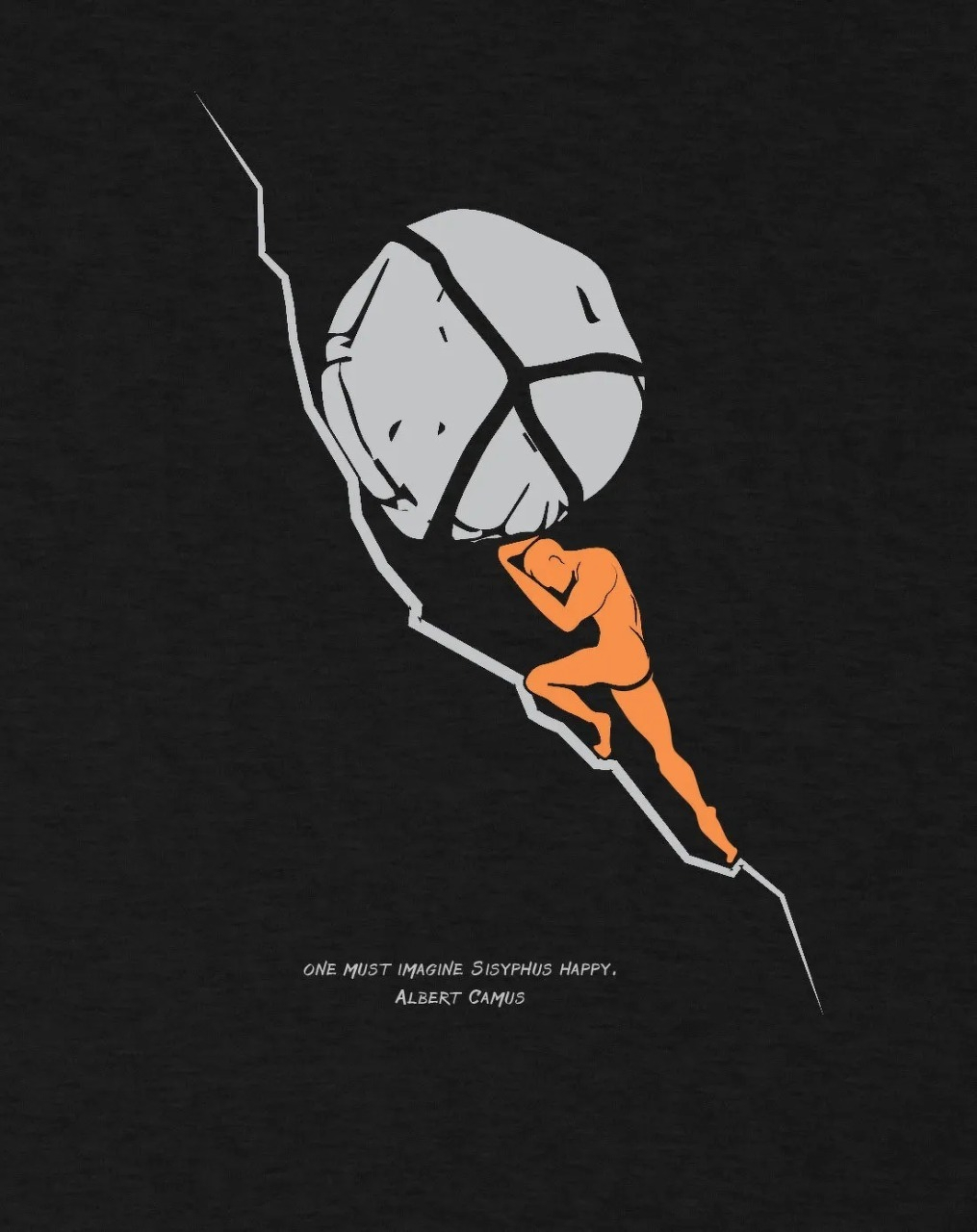
Sisyphus, Crushed Under His Boulder
Sisyphus let out a deep sigh as he watched the boulder he had pushed for years roll back down once again. “Watching it tumble all the way to the bottom each time is definitely harder than pushing it up the hill,” he thought. “No matter how painful it is, at least when the entire weight of the rock is on your shoulders you do not have much room to think. You have only one goal — to get this damned thing to the top. But the moment its weight breaks away from your body and you are left alone with your thoughts, forced to face the absurdity and meaninglessness of what you are doing, there can be no greater torment than that.”
While he was lost in these thoughts, the rock had already finished rolling and was standing once more in its old place — the same point where everything began — waiting for Sisyphus to lift it again. First he looked upward, toward the sun. The heat was intense, and he felt the sun’s rays pierce through his body with hatred and fury. Then he looked downward at the rock he was condemned to, and began walking toward its shadow with heavy steps. “I remember my early days very clearly,” he continued thinking. “Every time I reached the summit with great effort, I believed with real hope that the rock would stay there and I would finally be free. But each time that damned piece of stone rolled down instantly without stopping even for a moment. And without giving myself time for disappointment, I rushed down with the same hope, thinking that maybe this time I would push it to the point where the suffering ends. Now I know very well that this suffering will never end; the rock will never stay there, and I will never be free. Yet I still repeat this every single day, and to be honest, I do not know why. Whenever I try to think about the reason, I find myself face to face with an absurd emptiness I cannot escape. In this endless void, neither my suffering nor the existence of the rock carries any meaning at all. Everything seems like a part of something whose existence I cannot even be certain of. So to free myself from these disturbing feelings, I again surrender my body to the will of that stone. At least under the weight that gives my existence some kind of excuse, I try to crush the thoughts that surround me. But once the rock moves away from me, I am left with nothing to take shelter in against this emptiness. Every time I am left defenseless, this absurd void surrounds me again, and each time it tries to pull me deeper into its nothingness, trying to separate me from my rock. To escape this state, I try to return to the only thing that still feels familiar — my suffering, the rock I am destined to push. Perhaps the unfamiliar thing is not the rock but my own hands pushing it, my tired feet trying to step forward, or all the strength I spend to push it — in short, perhaps the unfamiliar thing is me. I cannot say. Each passing day I become more distant from myself; there is no connection between who I was in the beginning and who I am now, even though we are both trying to push the same rock to the same summit. I would not be wrong to say that every new day I fail to recognize the ‘me’ from yesterday. Maybe.”
Thinking all this, he noticed he had reached the same point again — where the rock stood. He looked at it. The rock looked larger than ever, which surprised him, even though it was the same boulder he had carried for years. He did not feel the need to dwell on the thought. He once again moved behind the rock, standing in the position from which he could push it. By now he was almost hidden from the scorching sun; its rays no longer bothered his body. Then he placed both hands on the boulder and began to push with all the strength he had. Either the rock was heavier than usual, or he was not as strong as before; he did not know which, but in any case, the task had become far more painful. Despite everything, Sisyphus continued, pushing the rock slowly upward. For the first time, he could not completely free himself from his thoughts. “To do something without knowing why you do it… I think there can be no heavier burden than that,” he thought as he pushed the stone uphill.
Despite the weight, he had made considerable progress. More than half the path was already behind him. Now the most difficult part began — the steepest section of the hill — and Sisyphus had almost no strength left from exhaustion. He paused for a moment and looked at the rock he sought refuge in against his thoughts, but he could not recognize it. It felt as if he were seeing this rock for the first time. He looked at his hands resting on it and could no longer tell what he was touching. Sisyphus did not understand. In front of him stood a growing, unfamiliar mass. He tried to push, but he could not find the strength in his shoulders to lift its weight. The enormous piece of nothingness that once used to be his rock had begun pushing him backward. He looked down at his feet sliding behind him, and what he saw terrified him; the ground beneath his feet had disappeared. Panicking, he looked around while trying to resist the weight pressing down on him. Sisyphus saw that everything around him had begun abandoning its own existence, and he realized he was inside the very absurd void he had feared. Terrified in this uncertainty, he forgot the weight above him for a moment. His muscles loosened, and he withdrew his hands from the unknown mass that had once been his rock. That enormous mass, as if waiting for this opportunity, attacked instantly; with all its weight it crushed Sisyphus and, without caring about its victory, continued rolling downward in the same manner as always. Sisyphus lay motionless, his body crushed by the pain. The pain brought him back to his senses, and as he watched the boulder roll downward, he understood that the “foreign mass” that crushed him was indeed his own rock. The absurd void he spoke of vanished as well. He had returned to his own reality.
As he lay weak and motionless, Sisyphus felt something he had never felt before — the feeling of his approaching death. He understood that the suffering he had endured for years was over, that he would never need to touch that damned rock again. He had finally reached his freedom. The sun found him again with its scorching rays, but this time he felt as if the sun was acting with love and gentleness. For the last time, with tired eyes, he looked at his rock, and with a satisfied expression on his face, he closed his eyes to finally reach his freedom.
Sisyphus was happy, perhaps for the first time in his life.